Showing posts with label editing. Show all posts

Sunday, October 15, 2017

Proofreading is an art

Proofreading is an art

From the first draft to the second last, my writing partner and I send chapters back and forth. We ask questions, make suggestions, point out errors in time lines, holes in plot lines, identify discrepancies in character development, and highlight the great bits.

Finally, we come to the second last draft—the one that requires the scrutiny for details. Our goal is always to have a “clean” manuscript.

My writing partner puts the chapters into one document, sends it to me, and I send it to my Kindle.

Why?

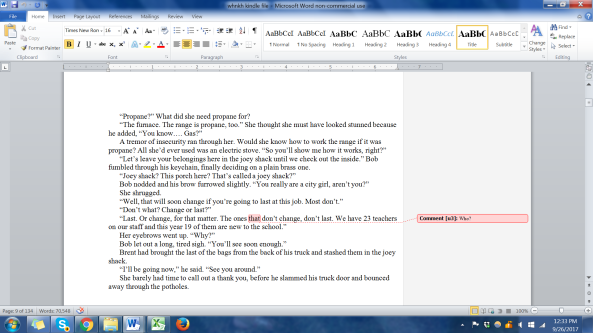
I’ve learned that reading on the Kindle puts me in “book” mode and I see the things I miss on the big screen. Note that this draft is already formatted for ereaders so I’m seeing what the buyer will see. Periods in the wrong place, a word that just doesn’t work, “is” when it should be “it,” and a couple of times I spot a missing word that needs to be added, or an extra word to be deleted.

I find a few “that” where I think it should be “who.” I make note of them and my writing partner emails back.

Just now I was looking up when to use who and that. It's okay to use that for a person, animal, or thing. The criterion has more to do with whether it's a restrictive clause or not (whether the antecedent is named and whether the sentence can stand without the whole clause). 
As far as I can tell from that, it's okay to use "that" in those cases where I have used it. It's a complicated thing though.

I see this sentence, Dad had moved to Regina to teach high school there. I comment,
I think at some other point, her dad was teaching in a college not high school.

I bookmark each page that needs attention on my Kindle and then go back to the computer copy to add my notes with Track Changes. No, I don’t scroll through pages and pages to find the one I need. I pick an unusual word on the page I’ve bookmarked and then use Find to get to the right page on the computer.  

I send the file back to my writing partner. She writes, I went through your suggestions. I had found some of them but missed others, so thank you!” 

I offer to read it one more time, but she declines. I know she’ll go through it one or two more times. Our goal is to have an error free document and we get it right most of the time. After all, two heads are better than one.

www.darlenejonesauthor.com

Wednesday, December 9, 2015

Re-reading my own books


An author spends hours writing the first draft of a novel and then many more hours editing, proofing, and rewriting. We agonize over plot lines, character development, and word usage. We keep an eye out for proper grammar and punctuation. We have beta readers and writing partners and critiquing groups to guide us along the way to publication.

We set up our books on Amazon and Smashwords and Createspace. Copies of our books sit on our bookshelves and our ereaders, but we don’t open them. We’re too busy marketing and writing the next book and reading whatever we can get our hands on, because writers are above all readers.

It came as a surprise to me one day a few months ago when I had an urge to reread my own work. After four years, I expected to see them in a new light—and I did.

I found myself enthralled once again in the story I knew so intimately. With the fresh perspective of time away: there was much that I loved, a few typos, and a few bits that made me wince. How could I have repeated myself like that?

Back to work it was for yet more editing.

Perhaps in four years’ time I’ll read them again, but for now, I’m very happy with my work and it’s on to the next novel:

 When the Sun was Mine  - now available in all formats. www.emandyves.com


Friday, September 25, 2015

What a reader can do


Email from my writing partner:

I had a note from the woman I pitched Embattled to. She said:

I bought your friend’s book, Embattled.  I had to start the book over when I hit page 14.  I was very confused.  Think I am over the hump now…

I wrote back. I said that this was a problem you had tried to deal with right from the beginning but if she could get past the first part she'd enjoy it and that your other books in the series don't have that problem and that I admire your writing. I told her you paint pictures with words.

This was not good, not good at all. I thought I’d solved the problem, but if readers still couldn’t get through the first few pages of Embattled, they’d never finish it, let alone go on to read the rest of the series.

My dilemma now is how to fix it. Do I rewrite the first few chapters? Do I rewrite the whole book? I’m finished the series and my new work in progress is something entirely different. At the moment, my head is not back with Embattled and I don’t know what to do. I can’t see any fix in this.                     

Email from my writing partner:

She wrote back:

Darlene might want to revise her book and add a prologue…

That was my thought when I returned to the beginning.  All confusion could be remedied with a short prologue with the male character and his sister giving a bit of what is going on before you reach that page where it makes sense.  There does not have to be much…She might be losing a lot of readers by not grabbing them at the get go… 

OMG! Why hadn’t I thought of that? This could be a simple solution to what seemed to be a complex problem.

Email to my writing partner:

I'm struggling with a “fix." I’m not keen on a prologue as some readers skip those. And as Robert Sawyer says, “Start where the story starts.” Maybe I could add this as the first scene of chapter one. Trouble is, I'm not quite sure how to do it. 

Here's what I've come up with so far - pathetic attempt, but a start ... maybe. 


Email from my writing partner:

Yes! That works.

Encouraging words, but we’ve both worked on the book for such a long time, I’m not sure we’re seeing this as clearly as we should.

Email to my writing partner:

Do you think the lady who's reading my book would take a look and say if she thought it would help or not? 

Email from my writing partner:

Do you want me to send this to her? I'm sure she'd be thrilled to think you cared about her opinion.

I ask her to please send it. I’m so wrapped up in this now that I don’t just want to know her opinion; I need to know her opinion.

Email from my writing partner:

She says:

That is perfect!  What works is that now you know when Em starts bouncing that it makes sense…  One suggestion:  Change it from Chapter 1 to Prologue.

Hope this helps!

Yes! It helps. Actually, it’s a minor miracle for this author.

Thank you to this reader and all who are so helpful to authors.


Friday, September 4, 2015

What a reader can do


Email from my writing partner:

I had a note from the woman I pitched Embattled to. She said:

I bought your friend’s book, Embattled.  I had to start the book over when I hit page 14.  I was very confused.  Think I am over the hump now…

I wrote back. I said that this was a problem you had tried to deal with right from the beginning but if she could get past the first part she'd enjoy it and that your other books in the series don't have that problem and that I admire your writing. I told her you paint pictures with words.

This was not good, not good at all. I thought I’d solved the problem, but if readers still couldn’t get through the first few pages of Embattled, they’d never finish it, let alone go on to read the rest of the series.

My dilemma now is how to fix it. Do I rewrite the first few chapters? Do I rewrite the whole book? I’m finished the series and my new work in progress is something entirely different. At the moment, my head is not back with Embattled and I don’t know what to do. I can’t see any fix in this.                     

Email from my writing partner:

She wrote back:

Darlene might want to revise her book and add a prologue…

That was my thought when I returned to the beginning.  All confusion could be remedied with a short prologue with the male character and his sister giving a bit of what is going on before you reach that page where it makes sense.  There does not have to be much…She might be losing a lot of readers by not grabbing them at the get go… 

OMG! Why hadn’t I thought of that? This could be a simple solution to what seemed to be a complex problem.

Email to my writing partner:

I'm struggling with a “fix." I’m not keen on a prologue as some readers skip those. And as Robert Sawyer says, “Start where the story starts.” Maybe I could add this as the first scene of chapter one. Trouble is, I'm not quite sure how to do it. 

Here's what I've come up with so far - pathetic attempt, but a start ... maybe. 


Email from my writing partner:

Yes! That works.

Encouraging words, but we’ve both worked on the book for such a long time, I’m not sure we’re seeing this as clearly as we should.

Email to my writing partner:

Do you think the lady who's reading my book would take a look and say if she thought it would help or not? 

Email from my writing partner:

Do you want me to send this to her? I'm sure she'd be thrilled to think you cared about her opinion.

I ask her to please send it. I’m so wrapped up in this now that I don’t just want to know her opinion; I need to know her opinion.

Email from my writing partner:

She says:

That is perfect!  What works is that now you know when Em starts bouncing that it makes sense…  One suggestion:  Change it from Chapter 1 to Prologue.

Hope this helps!

Yes! It helps. Actually, it’s a minor miracle for this author.

Thank you to this reader and all who are so helpful to authors.


Friday, February 13, 2015

Editors Are Essential


“You must have an editor.”

“Every author needs a second set of eyes.”

“Correct grammar and punctuation are essential to all writing.”

“Self-published authors are negligent if they put out a novel with errors.”

“Those who publish unedited, error filled work give self-published authors a bad name.”

True. True. True.

But self-published authors aren’t the only guilty ones.

One well known author had a main character sick in his hotel room, but after informing his travel companions that he was staying in bed, he miraculously appeared with the group on the tour bus.

In another Random House novel, two women find a naked corpse. He’s naked …, but a note is pinned to his shirt.

Or take the case of the child hiding in a hole. A truck pulls up and parks over the hole. All the child can see is the underbelly of the vehicle and the boots of the driver when he gets out. The child can also see the mother’s sandals. “The man looked straight at my mother.” Sorry, but the child can’t possibly know that.

I’ve read books where the names of the characters were spelled differently throughout, or where the names were mixed up. I’ve read books with grammar errors, spelling errors, punctuation errors. While these are perhaps minor in comparison with the examples above, they diminish the power of the story and in some instances are so distracting that the reader gives up.

Perhaps, even with the most diligent of proof reading, errors will still be found, but we must always aim for perfection.

How then do we produce an error free book?

1.     Read your manuscript on the computer watching for details.
2.     Send it to your ereader and read again. You’ll be surprised at the things that show up in a different format.
3.     Print it out and read it again.
4.     Read it aloud. You’ll find that what you say and what is on the page won’t always be the same. Go with the version that came out of your mouth.
5.     Get someone else to read it, but not just anyone. Friends and family will be too kind and say what they think you want to hear. Your “reader” should be an author too. They’ll know what to look for and will tell you what needs correcting.
6.     Join a critiquing group. Free editing from multiple readers with the same goals as you—all want to write well.
7.     Get a writing partner and send chapters back and forth. Not only will your partner edit, he or she will make suggestions for the story line, a valuable addition to your thought processes.
8.     If you can afford it, hire a substantive editor, a copy-editor, or a proofreader. Doing so will be money well spent.


Substantive Editing Services – contact Darlene Jones
 darlenejones47@hotmail.com                                                                                  www.emandyves.com


Friday, February 6, 2015

Substantive Editing Service


I wrote a novel. With no experience, no creative writing classes, and no collaboration, I wrote a novel. With an astounding amount of naiveté, I pitched to literary agents and received a resounding round of rejections.

Something was clearly wrong. I looked for help and found it with a substantive editor who read my prized four hundred page manuscript and sent me back several pages of notes outlining the numerous things I needed to do to make my novel “work.” Here are some examples of the feedback.

Too much emotion in the first chapter—you have a whole novel. Spread it out.
Much of it comes across as preachy. Here are examples of what I mean.
People don’t speak in full sentences.
You’re trying to fit too many themes into one novel.
There are scenes in your novel that do not advance the story.
Your characters are too perfect. Real people have flaws, even the best of them.
Substantive editing is the first step in the editing or revising process.

As a substantive editor, I:
• am your collaborator and biggest fan,
• share your desire to succeed in crafting the best possible story,
• help to ensure that your opening chapter hooks the reader and makes them know they “have” to read the book,
• help you to write a novel that will then hold the reader’s attention to the end,
• work with you on plot, tone, character, and setting,
• ensure that your story is well organized and flows,
• coach you on sentence structure and word choice,
• identify passages that the reader would be inclined to skip and therefore should be deleted,
• help to ensure dialogue is “real” and that dialogue tags are used correctly,
• suggest changes to heighten tension,
• help ensure that point of view is consistent in each scene,
• provide you with a free sample edit of the first chapter.

Here's an example from my own work. How many characters are mentioned? How many things discussed?

I screwed up. Big time. I’ll be banished. Or executed.
Why am I telling you this? I need to tell someone. Mentor, the ice-berg, wouldn’t listen. The members of the Grand Council have heard all they want to hear. I answered their questions, for far too short a time, in my opinion. How could they possibly understand with such a cursory interview?
The Guardians? They don’t deign to converse with anyone. Sent cryptic messages to the Council Chair. How many are there? Three. I think. The general belief is that they operate like a tribunal. But who knows?
Never mind that now. It’s me you need to be concerned with, me you need to listen to. I could be dead soon and I have so much to say. You’ll understand of course. The catch in the throat, the tingle in the abdomen, the trembling of the knees, the tightening of the abdomen… But why am I telling you all this? You know emotion. You were born with it, enveloped in it, experienced it all
Your life—the love, hate, fear, the excitement, anticipation, worry—so many
New words to learn for so many new feelings. I learned them all because of her.
Who? you ask. Why, my little soldier of course. It’s a long story. Make yourself
comfortable.

Confused? With seven characters and at least fourteen different topics in a few short paragraphs, you must be. So am I and I wrote it. After working with my substantive editor this whole approach was lost in the dust.

I also dropped whole chapters. Two in particular still haunt me. A main character was being interviewed which resulted in a whole lot of talk. Imagine reading a televised interview instead of watching it; two men talking about the action. Exciting, eh? In the new version, I wrote the fight scenes, the love scenes, etc. Telling became showing—much more interesting for the reader. And, I might add, for the author to write.

I’ve spent a lot of time working on my novels; from the first draft to the final is a test of endurance. My father used to say, if something is worth doing, it’s worth doing right.

I say, if something is worth publishing, it’s worth writing well.

I can help you achieve that goal. Please contact me with any questions or for a free sample of my editing.
darlenejones47@hotmail.com 
www.emandyves.com

Sunday, April 20, 2014

Le me introduce you to Uzo


I don’t remember how we met. Uzo reminds me that he was surfing Wordpress looking for authors, found my blog, and read some of the posts about Mali. He made a comment, I responded and a new friendship was born.

Uzo is a young Nigerian with a blog. He lives in Asaba, Delta State (South-South Nigeria), one of the oil producing states in his country. I’m an older Canadian with a blog. I live a world away (in so many respects) on Vancouver Island, Canada.

Uzo writes novels. I write novels. Uzo writes in English, which is not his first language. As he says, “English is quite a vast language. Every day is a learning process for me.”

We begin by talking about books. We both like Chimamanda Ngozi Adichie. I’d read Half a Yellow Sun. He told me about Purple Hibiscus. Here’s what he had to say about that book. “Purple Hibiscus is a wonderful story. Adichie did a marvelous job there from the first person pov. Kambili's account is so real and reflects the life of a rich, caged Igbo child-woman during one of the military regimes in Nigeria.”  We’re both anxious to read Americanah.

Uzo says, “I’m a no-good writer. I'm just a wannabe like you guys call it.” On the contrary, Uzo is a powerful writer. Here’s a sample.

Although the Liberian war is now over, I cannot wish away the memories. There are nights in my sleep when I still find myself dressed in army uniform, AK-47 ready. On these nights I hear the voices of parents calling their children; others joking, shouting: “Where’s your bunker?” The air cracks and I hear the sounds of diving jets and stuttering LMGs. Fire, blood, bullets and bodies everywhere. Things soon simmer to normal as danger passes. People fill the streets, young boys and girls going on various errands. Then he appears in a blood-stained enemy uniform. His oily dark face is teased with abandon. He’s about to aim his rifle at me. In my dreams, he dies in different ways. I’m his killer. Something tells me that he is my son. But I’m too afraid to believe it.

I’m not a professional editor, but I’ve offered to help Uzo with his English as he’d be drained if he had to pay an editor, so files are sent back and forth. I’m careful not to tamper with the uniqueness of his voice.

Only the eyes that moved swiftly would see the legs that desperately sprinted across the farms and pathways. Thereafter thoughts would arise if the runner was after something, or rather, was the prey.


Beautiful, right? And yes, my life, as a person and as a writer, is richer for having met him. That’s the beauty of the Internet.